How to rejuvenate your face by 10 years?
1 Abril - 2026
There is a constantly repeated idea: that to look younger, you have to change your face.
In reality, the opposite is true.
Well-done facial rejuvenation does not transform your face; it returns it to a point where it looked rested, balanced, and natural. And that, in most cases, does not require surgery.
In consultation, we see it daily: patients who look between 5 and 10 years older not because of a single wrinkle, but due to a combination of small changes (loss of volume, sagging, lack of luminosity) that, when combined, age the expression.
The key is not in a miracle treatment. It's in a plan. -Dr. Daniel Zarza
Why does your face age before the rest of the body?
The face does not age the same as other areas. It does so earlier and, above all, more visibly.
On one hand, it is the area with the greatest accumulated sun exposure. Over the years, ultraviolet radiation degrades collagen, alters skin texture, and accelerates what we know as photoaging. It's not just an aesthetic issue: it's a structural change.
To this is added the progressive loss of fat volume. Over time, facial fat compartments reduce and descend, resulting in a more sunken appearance in some areas (like cheekbones or under-eye bags) and heavier in others (like the facial oval).
Additionally, the face is in constant motion. Every gesture (smiling, frowning, squinting) leaves a mark. Dynamic wrinkles eventually become static wrinkles.
And there's a factor that is often overlooked: the neck.
While the face receives attention, the neck is often forgotten… and ends up revealing age more clearly than the face itself. -Dr. Daniel Zarza
Biological age vs chronological age: why you can look older or younger
Not all faces age at the same rate. -Dr. Daniel Zarza
Two people of the same age can show differences of up to a decade in their facial appearance. This is due to what we call the biological age of the face, which is influenced by factors such as genetics, sun exposure, lifestyle, or skin care.
In consultation, more than age, what we assess is the real state of the face. -Dr. Daniel Zarza
There are very clear signs indicating facial aging:
- Loss of luminosity and skin quality
- Blurring of the facial oval
- Appearance of nasolabial folds or marionette lines
- Tired or sunken look
- Thinner or dehydrated lips
- Sagging in the neck area
What matters is not how old you are, but what your face needs at this moment.
The age-based plan: what your face needs in each decade
One of the most common mistakes is seeking a specific treatment hoping it will solve everything.
There is no single procedure capable of rejuvenating 10 years on its own. What does exist is a medical approach based on combining techniques according to age, facial anatomy, and the degree of aging.
At Instituto de Benito, this approach translates into personalized plans that evolve over time.
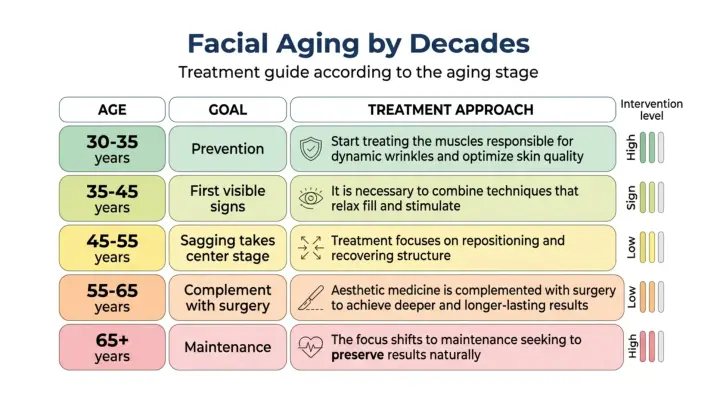
Broadly speaking, we can understand facial aging by decades:
- 30-35 years: the goal is prevention. Start treating the muscles responsible for dynamic wrinkles and optimize skin quality.
- 35-45 years: the first visible signs appear. Here it is necessary to combine techniques that relax, fill, and stimulate.
- 45-55 years: sagging begins to be prominent. The treatment is aimed at repositioning and recovering structure.
- 55-65 years: in many cases, aesthetic medicine is complemented with surgery to achieve deeper and longer-lasting results.
- 65+ years: the approach becomes maintenance, seeking to preserve results naturally.
More than a fixed chart, this should be understood as a guide. Each face ages differently.
Treatments that truly rejuvenate (and why they work better combined)
When we talk about facial rejuvenation, we are not talking about trends, but clinical tools with specific objectives.
Botulinum toxin treatment remains the basis for softening dynamic wrinkles and preventing their progression. It does not change the face, but it does change the expression: it makes it look more rested.
Hyaluronic acid, on the other hand, allows for the recovery of lost volumes and improvement of facial structure. Used correctly, it does not 'fill', but repositions.
There are also biostimulatory treatments, such as polylactic acid, which do not provide immediate volume but stimulate collagen production. The result is progressive but much more natural in the long term.
Technologies like focused ultrasound or thread lifts allow acting on sagging without resorting to surgery, although they have their indications and limitations.
And when these treatments are no longer enough, surgery like a facelift remains the most effective option for repositioning deep structures.
The key is not to choose one. It's knowing when to use each one. -Dr. Javier de Benito
Frequently asked questions about facial rejuvenation
How to rejuvenate the face naturally without surgery?
Non-surgical facial rejuvenation is based on combining treatments that act on different layers of the face. It's not just about eliminating wrinkles, but about restoring volume, improving skin quality, and repositioning tissues.
In practice, this usually involves the use of botulinum toxin to relax the muscles, hyaluronic acid to restore structure, and biostimulatory treatments to improve collagen.
When planned correctly, the result is not artificial, but a more rested and balanced version of the face.
Is it possible to look 10 years younger without surgery?
Yes, in many cases it is possible to achieve a visible rejuvenation of several years without surgery. The key is to treat the face globally ("Full Face" approach) and not focus on just one area. The combination of treatments allows for improved expression, restored proportions, and the progressive softening of aging signs. However, when there is significant tissue sagging, surgery may be necessary to achieve deeper results.
What role do facial exercises play in rejuvenation?
Facial exercises tone the facial muscles, improve circulation, and can give a firm and vital appearance. However, they are a complement and do not replace sun protection, cosmetic routines, or medical or surgical treatments.
What is the best treatment to rejuvenate the face?
There is no single "best treatment." Effective facial rejuvenation is based on a personalized plan. Each technique has a different function: some relax, others fill, others stimulate or tighten. The result depends on how they are combined and when they are applied.
Therefore, prior medical evaluation is essential to design a treatment suitable for each patient.
How long does it take to see results in facial rejuvenation?
It depends on the type of treatment. Some, like botulinum toxin, start to show effects in a few days. Others, like biostimulators, require weeks or months to show their full effect. When following a complete plan, results are usually noticeable progressively over 3 to 6 months, which helps ensure the change is natural and not abrupt.
At what age is it advisable to start anti-aging treatments?
There is no exact age, but in many cases, people start between 30 and 35 years old with a preventive approach. The goal at this stage is not to correct, but to delay the appearance of signs of aging. As the years go by, the treatment evolves towards volume replacement, skin improvement, and sagging treatment.
More than age, the important thing is the condition of the face.
Is it safe to combine several facial treatments?
Yes, as long as there is proper medical planning. The combination of treatments is, in fact, the foundation of modern facial rejuvenation. It allows addressing different causes of aging and achieving more comprehensive results. The risk arises when techniques are applied without prior diagnosis or without a global strategy.
How much does a complete facial rejuvenation plan cost?
The price can vary greatly depending on the initial condition of the face, the necessary treatments, and the duration of the plan. A preventive approach is not the same as treating advanced sagging. Therefore, rather than discussing a fixed price, it is important to carry out a personalized assessment that allows defining a realistic and progressive plan.
Are the results of facial rejuvenation permanent?
No. Aging is a continuous process.
Treatments allow improving the appearance of the face and slowing down that process, but they require maintenance over time. The frequency will depend on the type of treatment and each patient. A good plan not only seeks results but also their sustainability.