14 Abril - 2026
Facial sagging: real causes and most effective treatments
Facial sagging is one of the most evident signs of skin aging. It manifests as a loss of firmness and tension in the facial skin
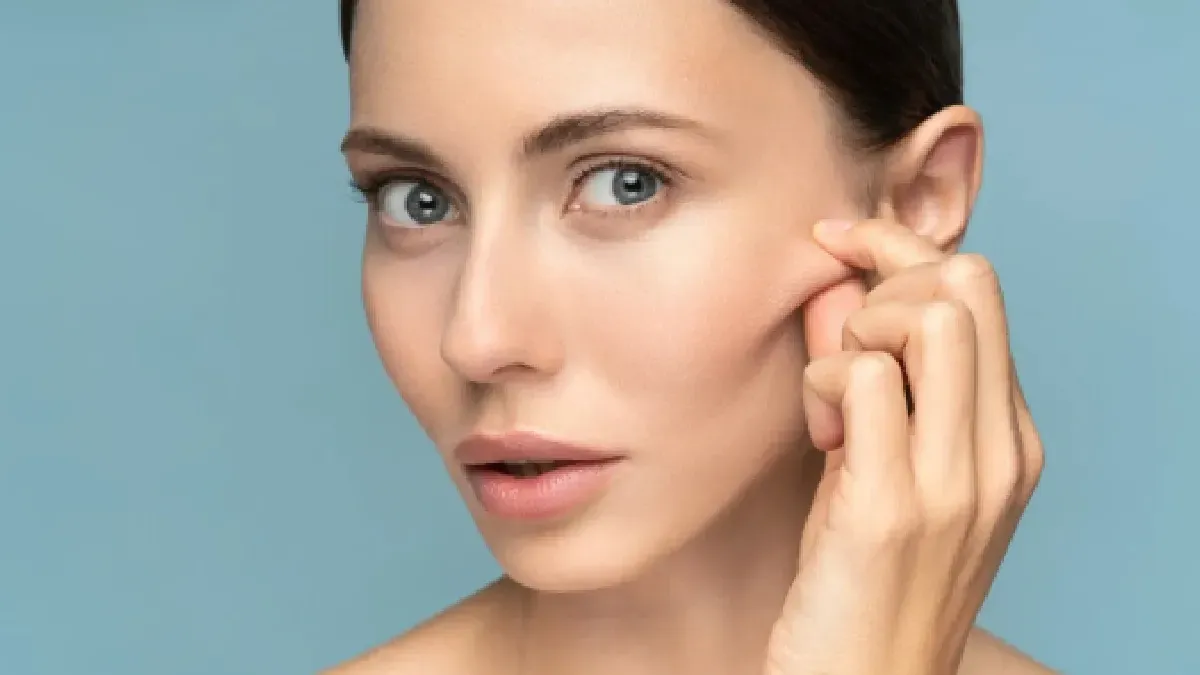
Facial sagging is one of the aging signs that concerns us the most because it changes something we appreciate when we look in the mirror: the contour of the face. It appears progressively, almost without warning, and one day we notice that the facial oval is no longer where it was, that the cheeks have lost tone or that the gaze looks more tired than rested. The good news is that today we have treatments that work at any degree of sagging. The important thing is to choose the right one for each case (no more, no less) and start in time.
In this guide, we explain exactly what facial sagging is, why it appears, how to identify your degree, and what options you have from aesthetic medicine to surgery. All with medical criteria and without package recommendations.
What is facial sagging and when does it appear?
Facial sagging is the loss of firmness, elasticity, and support of the facial tissues. It is not the same as wrinkles (dynamic or static lines on the skin) or volume loss (cheeks that "empty"), although it often coexists with both. When we talk about sagging, we refer to the descent of facial structures: the skin falls, deep tissues reposition downward, and what we technically call facial ptosis appears.
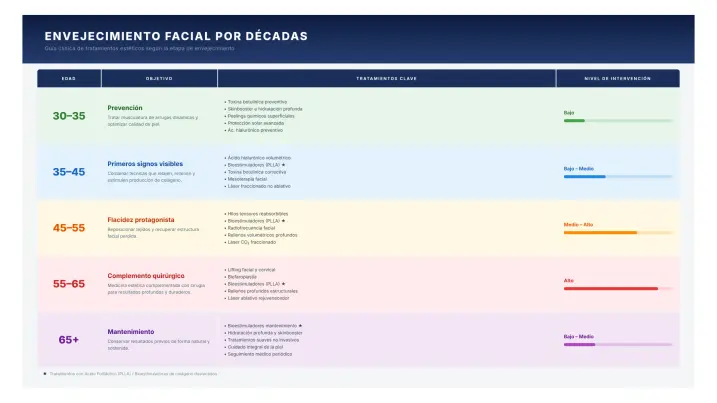
The first signs appear between the ages of 30 and 35, very subtly: loss of radiance, less defined facial oval, slightly more relaxed cheeks. From the age of 45, the signs become evident (marked nasolabial fold, incipient double chin, descent of the corners) and from the age of 55, without action, facial descent is the dominant piece of facial aging.
Not everyone ages the same. There are genetic factors (the quality of hereditary collagen and elastin), external factors (sun, tobacco, diet, sleep), and hormonal factors that accelerate or delay the process. That's why some people at 50 maintain a defined oval and others at 40 already show visible sagging.
Causes of facial sagging
Understanding why sagging appears is the first step to addressing it with the correct tool. There are seven main causes, and they almost always act in combination.
Natural loss of collagen and elastin
Collagen is the protein that gives firmness to the skin, and elastin allows it to regain its shape. From the age of 25, collagen production decreases by approximately 1% per year. Elastin follows a similar curve. This means that by age 50, we have lost about 25% of our original collagen. It is the universal cause and the one that most explains the progressive onset of sagging.
Reduction of endogenous hyaluronic acid
Hyaluronic acid not only provides hydration: it is responsible for the "turgidity" of the skin, that full and firm sensation of young skin. The skin produces less hyaluronic acid each year, resulting in thinner skin with less support.
Bone resorption
A cause that is almost never mentioned but is decisive: facial bone also loses volume with age. The upper jaw, mandible, and orbital cavity slightly resorb, and by losing that bone support, soft tissues (skin, fat, muscle) are left without structure and fall. That's why from a certain age, filling only with hyaluronic acid is not enough: the bone "scaffold" no longer supports as before.
Loss of facial fat compartments
The face has fat pads that give volume to the right areas: cheekbones, temples, forehead. Over the years, these compartments atrophy and descend, and the face goes from having a full and "young" appearance to a more elongated one with grooves.
Hormonal changes
Menopause is a documented accelerator of facial sagging. The drop in estrogen drastically reduces collagen production (up to 30% in the first five years of menopause) and also affects skin thickness. In men, andropause has a similar but more gradual effect.
External factors: sun, tobacco, pollution, stress, and diet
The sun is, after time, the main accelerator of facial aging. Cumulative exposure destroys collagen and elastin fibers (photoaging). Tobacco reduces tissue oxygenation and degrades elastin. Pollution generates free radicals. Chronic stress maintains high cortisol levels, which also degrades collagen. And a diet poor in proteins, antioxidants, and water leaves the skin without the raw materials to regenerate.
Rapid weight loss
When many kilos are lost in a short time, especially after the age of 40, the skin does not always have the capacity to retract, and a "deflated" effect appears: the skin becomes loose over structures that have thinned. It is a common scenario after bariatric surgery or very restrictive diets.
How to know what degree of facial sagging you have
Not all sagging is treated the same. The choice between aesthetic medicine, minimally invasive treatments, or surgery depends on the degree and the objective. This indicative table helps you position yourself.
This classification is indicative: there are 35-year-olds with moderate sagging due to genetics and 60-year-olds with mild sagging due to good habits. The decisive factor is not chronological age, but the real state of the face, and that can only be well assessed in a face-to-face consultation.
Non-invasive medical treatments for facial sagging
When sagging is mild or moderate, aesthetic medicine offers very satisfactory results without the need for surgery. These are the treatments with the best evidence.
Radiofrequency
Applies controlled heat to the deep dermis using radiofrequency waves. It causes an immediate contraction of existing collagen and, in the medium term, stimulates the formation of new collagen. The results are progressive and usually require between 4 and 8 sessions, with subsequent maintenance. It is an excellent option for mild sagging and as a complement in other degrees.
Ultherapy (HIFU)
Ultherapy uses high-intensity focused ultrasound (HIFU) to reach the SMAS layer, the same structure treated in a surgical facelift, without touching the skin. It stimulates collagen production in depth and produces a progressive lifting effect, visible from 6-8 weeks and maximum at 3-6 months. It is one of the most effective non-invasive treatments for moderate sagging.More details on our dedicated Ultherapy page.
Biostimulation with polylactic acid
Polylactic acid (Sculptra) is a biostimulator that does not provide external volume but activates the body itself to produce new collagen. It is applied in microinjections distributed at strategic points. The results appear progressively between the first and third month and last up to 25 months. It is one of the most powerful tools against moderate sagging when seeking a natural and long-lasting result. We explain it in detail in our article on polylactic acid.
Calcium hydroxyapatite
Calcium hydroxyapatite (Radiesse) combines the immediate effect of filling with a medium-term biostimulatory effect. It provides instant volume and stimulates collagen for months. It is especially indicated for defining the jawline and restoring structural support.
Minimally invasive treatments
When aesthetic medicine is not enough and surgery is still excessive, minimally invasive treatments occupy a very useful space.
Thread lifts
These are biocompatible threads (polydioxanone or polylactic acid) that are inserted under the skin using a cannula and produce two effects: an immediate repositioning effect (the skin is lifted) and a progressive biostimulatory effect (the thread activates collagen). Indicated for moderate sagging in cheeks, jawline, and neck. The results last 12-18 months.
Hyaluronic acid fillers for repositioning volumes
Hyaluronic acid is not only used to "fill wrinkles". Applied judiciously to the cheekbones, jawline, and temples, it restores lost structural support and achieves a natural lifting effect. It is called the revolumetry technique and is one of the keys to modern rejuvenation.
Platelet-rich plasma (PRP)
It is obtained from your own blood. Platelet-rich plasma concentrates growth factors that stimulate skin regeneration. It improves skin quality and is especially used in areas such as the eye contour, neck, and hands. It does not have a direct lifting effect but enhances the results of other treatments.
Surgical treatments for advanced sagging
When sagging is advanced, surgery is the only option that truly restores youth to the face.Aesthetic medicine can complement, but not replace.
Traditional cervicofacial lift (SMAS)
It is the classic facial rejuvenation surgery. It treats the SMAS layer (superficial musculoaponeurotic system), repositions the deep tissues, and removes excess skin. Indicated for moderate-advanced sagging of the facial oval. The results are very good and last 8-10 years.
Deep plane lift
The most demanding technique and, today, the one that offers the most natural and long-lasting results. Unlike the classic SMAS, the deep plane releases the facial ligaments that hold the tissues down and repositions them as a block, without tightening the skin. The result is a younger face without that "stretched" appearance that reveals poorly done surgeries. The results can last 12-15 years. Learn more on our deep plane lift page.
Mini-lift or partial lift
Indicated for localized sagging in the lower part of the face, in younger patients, or as an entry point. Shorter scars and faster recovery than a full lift. Not suitable for very advanced sagging.
Mid-face lift
Specifically addresses the descent of the middle third: sagging cheekbones, deep under-eye circles, pronounced nasolabial fold. It is performed through discreet incisions and repositions the tissues in the center of the face. It is often combined with blepharoplasty.
How is the appropriate treatment decided?
The decision should never be "the trendy treatment" or "the cheapest one". It is decided in consultation by evaluating six variables:
1. Age and actual degree of sagging. Not chronological age, the current state.
2. Skin quality (thickness, elasticity, sun damage).
3. Bone structure (is there resorption that should be compensated?).
4. Facial volumes (is there a loss of fat pads to recover?).
5. Person's expectation (natural result, transformative, maintenance).
6. Available recovery time and budget.
At Instituto de Benito, we often recommend combinations called Full Face or global treatment: because each area of the face responds better to a different technique. Neuromodulators for the upper third, hyaluronic acid for repositioning volumes, biostimulators to improve skin quality, and surgery only when strictly necessary.
If your face does not yet need surgery, we will tell you. Overoperating someone who still responds well to aesthetic medicine is not good medical practice.-Dr. Javier de Benito
Frequently asked questions about facial sagging
At what age does facial sagging begin?
Prevention can start at 30 with gentle radiofrequency treatments, mesotherapy, active topical care. Corrective intervention usually begins between 40 and 45, when the first visible signs of sagging appear. Before 35, it is generally not necessary, except in specific genetic cases.
How many sessions do I need of Ultherapy or radiofrequency?
Ultherapy is usually applied in one session and results are seen in 3-6 months, lasting one to one and a half years. Radiofrequency requires 4-8 initial sessions and periodic maintenance. Your doctor will indicate the protocol according to your case.
When does aesthetic medicine stop working and I need surgery?
When sagging is advanced and the tissues have descended so much that no non-surgical treatment can lift them. This usually occurs from the age of 55-60, although it depends greatly on each person. The key sign is visible double chin, jowls (cheeks hanging over the jawline), and descent of the midface.
Can several treatments be combined at the same time?
Yes, and often it is the most recommended. Botox + hyaluronic acid + biostimulator is a common combination. Before a facelift, aesthetic medicine is often applied to prepare the skin, and afterwards to maintain the result. The correct combination is defined by your doctor.
What is the price of each treatment?
The range is very broad because it depends on the product, the area, the sessions, and the combination. Aesthetic medicine starts with moderate figures per session; a facelift is a significantly larger investment. In consultation, you receive a closed budget adapted to your plan, with financing if you need it.
How long do the results of the treatments last?
Mesotherapy and Botox: 4-6 months. Hyaluronic: 8-12 months. Thread lifts: 12-18 months. Polylactic acid: up to 25 months. Ultherapy: 12-18 months. Deep plane facelift: 12-15 years. Aesthetic medicine requires maintenance; surgery does not, but aging continues.
Is the deep plane facelift painful?
The surgery is performed under general anesthesia, so there is no pain during the procedure. The postoperative period may cause discomfort and swelling in the first few days, which are well controlled with the analgesic regimen. With our SYNAPTA® protocol, we significantly reduce postoperative pain and inflammation.
What is the best treatment for a double chin?
It depends on its origin. If the double chin is due to excess fat, submental liposuction or treatments like deoxycholate are usually sufficient. If it is due to skin laxity, cervical surgery or combined biostimulatory treatments are needed. The double situation of fat + laxity usually requires a combined approach, which is decided in consultation.