Medically reviewed by Dr. Lucrecia Villanueva body and breast surgeon, licence no. 282871279Published on 18 May 2026Updated on 28 September 2026
Is a 350cc implant too large?
350cc is not a size: it's a volume. To know if it fits, you need to assess breast base, own tissue, skin, constitution, and aesthetic goal.
Want to know if 350cc suits your anatomy?
Is a 350cc implant too large?
Short answer: it depends on your breast base (chest width in cm), the amount of tissue you already have, your height and weight, and your lifestyle. 350cc is not a size: it's a volume. There are women for whom 350cc fits perfectly and proportionately, and others for whom it is clearly too much. In this guide, we explain how to decide it well and why the figure "350cc" alone means nothing.
The question is poorly posed (and that's important)
It's one of the most common questions we receive in consultation:
"I've seen on social media that 350cc is the most common. Is it too large for me?"
The honest answer is that the question is poorly posed and understanding why will save you from disappointments, expenses, and, in some cases, a second surgery. An implant is not measured in sizes. An implant is measured in cubic centimeters (cc) of volume, but also in base width (cm), projection (cm), and profile. The same 350cc implant can look:
- Discreet and harmonious on a woman with a wide chest and own breast tissue.
- Excessive and disproportionate on a slim woman with a narrow chest and little gland.
- Sagging in a few years on skin with little elasticity.
- Perfect on a woman with a 12 cm breast base looking to regain post-lactation volume.
The common mistake is deciding "how many cc I want" by looking at a friend's result or an Instagram photo. The correct way to do it is the reverse: measure your anatomy first, decide the volume afterward.
Clinical note: 350cc does not automatically equal a C cup. In some anatomies, it may approximate a non-full C; in others, it may look like a D or be insufficient. The equivalence depends on the chest base, band size, own tissue, implant profile, and skin elasticity.
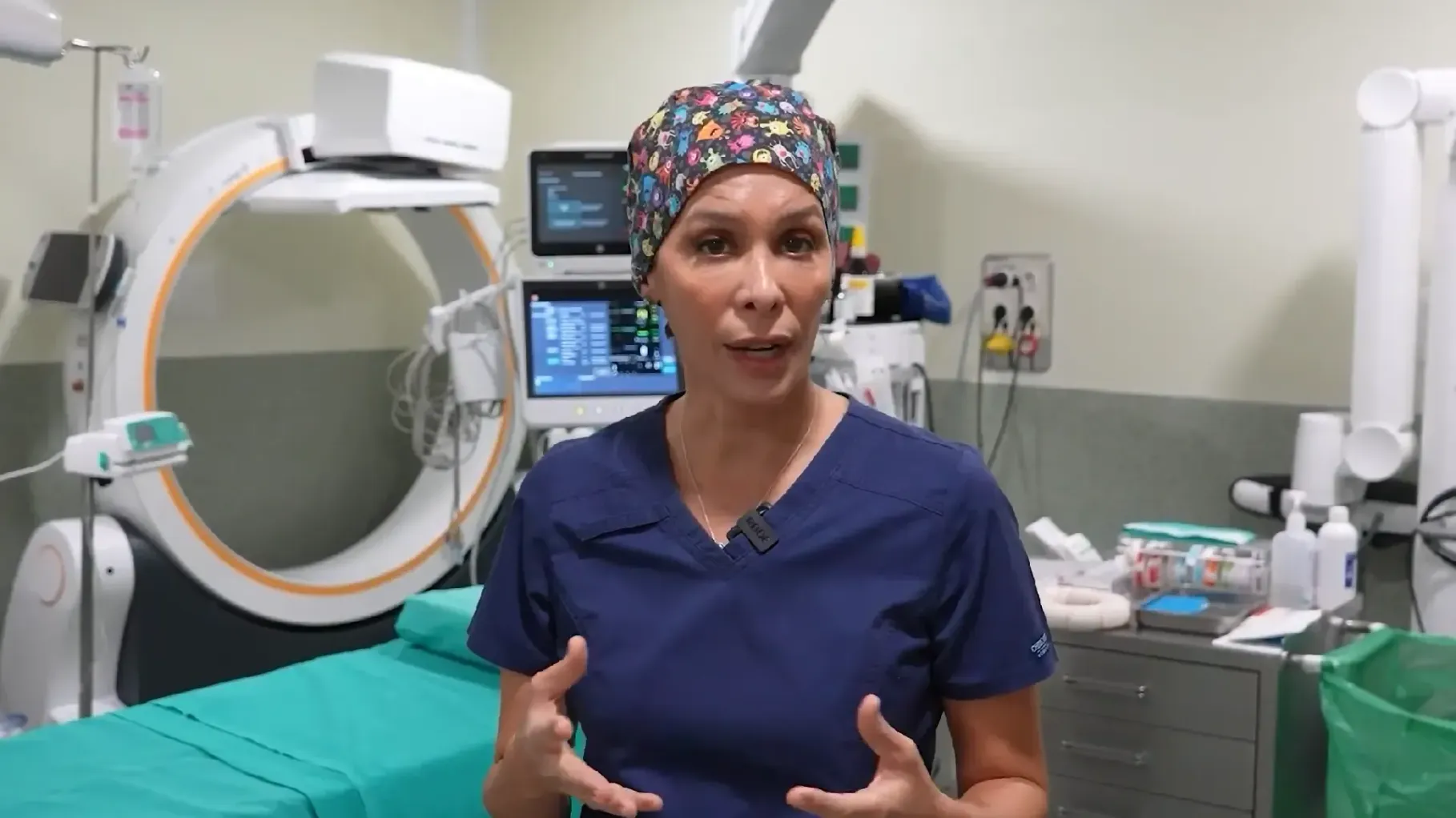
In this video, Dr. Lucrecia Villanueva explains why 350cc is a volume, not a size, and how the breast base and tissue change the result. Key points:
- Why the same 350cc looks different on a narrow vs wide chest base.
- How the pinch test and skin-stretch measurements guide volume.
- The difference between absolute final volume and how 'noticeable' the implant looks.
What exactly do 350cc mean?
Cubic centimeters (cc) are the unit of implant volume. To give you a reference:
- 150 cc ≈ content of a small liquid yogurt.
- 350 cc ≈ content of a standard-sized soda can (33 cl ≈ 330 ml).
- 500 cc ≈ half a liter of water.
As a rough reference (not a universal rule), it is accepted in literature that 130–150 cc added approximately raise a cup size. Therefore, 350cc usually mean a jump of 2 to 3 cup sizes, again depending on your base.
Important: there is no universal cc–size chart. Cups vary between brands (Calvin Klein is not Intimissimi, nor is Etam Triumph) and the "size" also depends on the underbust circumference. Deciding by size is deciding poorly.
350cc, what size is it? Why there isn't a single answer
It's the most searched question and also the one that is least accurately answered with a number. There is no fixed equivalence between cc and cup size for three specific reasons:
- The starting point matters. 350cc on an almost flat chest gives a different result than 350cc on a B with its own tissue.
- The cup depends on the underbust measurement, not just the implant volume.
- Sizes are not standardized among lingerie brands.
As a rough reference, 130–150 cc added approximately increase a cup size, so 350cc usually means a jump of 2 to 3 sizes. But "rough" is the key word: the actual size is only approximated after measuring your base and your tissue.
The 5 factors that DO decide if 350cc is too much for you
These are the parameters we measure in consultation before talking numbers:
1. Breast base (width of the chest in cm)
If your breast base measures 11 cm and you choose a 350cc prosthesis with a width of 12.5 cm, the implant extends laterally from the chest: "full armpit" appears, the cleavage looks forced, and in the medium term, the skin suffers.
2. Own breast tissue
If you start with an almost flat chest (little gland): your final size will be approximately that of the implant (≈ 350cc). The absolute volume will be smaller, but the prosthesis visually dominates: the skin and tissue are very thin, increasing the risk of visible rippling, feeling the edges, and a less natural finish.
If you start with a real B with your own tissue: your final chest will be the sum of your tissue + 350cc, that is, larger in absolute terms (it can reach a D-DD). But since you have gland and fat covering the implant, the prosthesis integrates and the result is more natural and "yours".
In summary: the less own tissue, the smaller the final chest but the more noticeable the implant. The more tissue, the larger the final chest but more natural. That's why 350cc can be a correct decision in a woman with little gland looking for a clear change, or in a woman with a B who just wants to "fill what was lost" after breastfeeding, resulting in two very different outcomes from the same number.
3. Height, weight, and general constitution
The same volume has very different visual readings depending on constitution:
- Woman 1.58 m · 50 kg with little gland → 350cc look very large, possible disproportion.
- Woman 1.68 m · 60 kg with moderate gland → 350cc usually integrate well.
- Woman 1.72 m · 65 kg with wide chest → 350cc may fall short.
4. Skin quality and elasticity
When the skin has little elasticity or the breast has sagged, sometimes volume is not the only decision: combining the augmentation with a mastopexy (breast lift) can be considered. And if you already have prostheses and are thinking about reviewing the volume, the prosthesis change follows a similar planning logic.
5. Lifestyle and aesthetic expectation
- Do you do impact sports (running, crossfit, horse riding)? Large volumes weigh, generate bounce, and are less comfortable.
- Do you work in direct contact with the public or a profession where the cleavage is very noticeable? There are patients for whom 350cc is exactly what they seek, and others for whom it is too exposed.
- Are you looking for a natural or explicitly prominent result? Both options are legitimate, but the optimal volume changes.
| Breast base | Guideline compatible prosthesis volume |
|---|---|
| 10.5 – 11.5 cm (narrow chest) | 200–290 cc |
| 11.5 – 12.5 cm | 270–360 cc |
| 12.5 – 13.5 cm | 320–420 cc |
| > 13.5 cm (wide chest) | 380 cc and above |
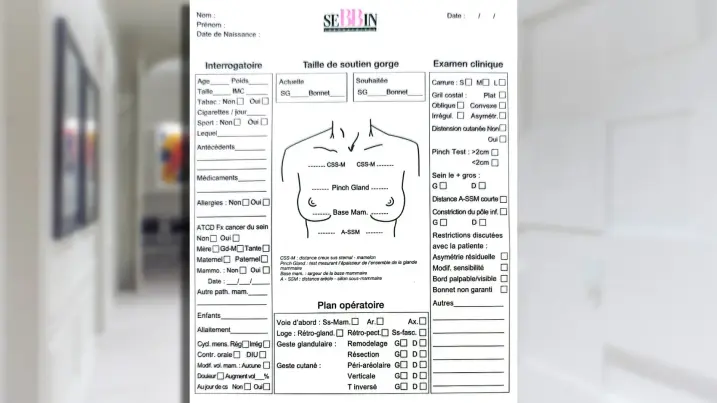
The dimensional method (Tebbetts): how we really decide
The dimensional method was systematized by John B. Tebbetts ("A system for breast implant selection based on patient tissue characteristics and implant-soft tissue dynamics", Plastic and Reconstructive Surgery, 2002;109(4):1396-1409). It is one of the international references for evidence-based implant selection.
- Width of the breast base (in mm).
- Pinch test: pinching of the upper and lower pole to measure skin thickness.
- Skin stretch: how much the skin envelope can stretch.
- Distensibility of the lower pole.
- Nipple height and current projection.
With this data, a range of optimal implant volume is calculated (not a single number), a prosthesis base width, and a profile (low, moderate, high, ultra-high). Only then is it tested with sizers (intraoperative or external samples) during the consultation.
That's why, at the first visit at IdB, we don't tell you "you're going to have 350cc". We tell you: "your optimal range is between 295 and 360 cc, with a moderate profile and a base of 12 cm within that range, you decide where you feel comfortable".
When 350cc is a good choice
These are the situations where, typically, 350cc fit well:
- Breast base 11.5–12.5 cm with moderate tissue.
- Post-lactation with lost volume and the need to recover "the breast you had".
- Mild-moderate breast asymmetry, where 350cc in one breast and 320cc in the other balance out.
- Significant weight loss that has left the breast empty with skin still having some elasticity.
- Patients with a clear aesthetic expectation: they want a "natural but noticeable" result.
When 350cc is probably too much
Conversely, warning signs where we usually recommend reducing the volume:
- Breast base < 11 cm with little gland → the prosthesis will extend laterally.
- Height < 1.55 m with very thin build and no prior breast → the change will be visually disproportionate.
- Skin with many stretch marks and little elasticity → high risk of ptosis in 5–7 years.
- Impact sportswoman who doesn't want to reduce activity → 350cc add significant weight.
- Patients with an expectation of a "discreet result" → 350cc are not discreet in most cases.
Real consequences of choosing a prosthesis that is too large
Choosing an implant beyond what the anatomy allows not only changes the aesthetic result: it can also increase the likelihood of discomfort, early sagging, or the need for revision. As a guideline, the complications most related to excessive volume or width are:
Good planning does not eliminate all risks, but it helps reduce disproportionate decisions before entering the operating room.
| Complication | Why it occurs |
|---|---|
| Visible rippling | In thin skins with little tissue coverage, the folds of the implant show through, especially in the lateral and upper pole. |
| Bottoming out | Descent of the implant below the natural inframammary fold. |
| Symmastia (sternal approach of the implants) | Due to medial over-dissection when trying to accommodate implants that are too wide. |
| Back and shoulder pain | In very large volumes, especially in women with a petite build. |
| Early replacement | Higher revision rate than in proportionate volumes. Literature places the reintervention rate at 10 years between 15% and 25%, and it increases with volumes disproportionate to the base. |
| Aesthetic regret | A significant part of explantations is done in patients who "went bigger than they wanted" |
What to Remember
350cc is neither "a lot" nor "a little": it is a volume that only makes sense alongside your breast base, your own tissue, the elasticity of your skin, and your lifestyle. This guide is informative and the ranges are indicative; they do not replace an individual medical assessment.
If you are deciding your volume, it is not useful to look for the fashionable number, but to measure your anatomy and work with a realistic and sustainable range over time. You can request a first visit in Barcelona, Madrid, or via video consultation.
If you are travelling to Spain for your surgery
Many of the patients who ask us about 350cc are researching from abroad. The process is designed so distance does not compromise safety:
- Video consultation first. Before any travel, Dr. Villanueva and the breast team can review your measurements and goals in an online assessment.
- Where surgery takes place. Procedures are performed in our Barcelona and Madrid facilities, in hospital-grade operating rooms.
- Follow-up after you return home. Post-operative reviews can continue by video consultation, and we coordinate with your local physician when clinically appropriate.
- European medical credentials. Our surgeons are MIR-certified and members of recognised societies including ISAPS; implants used are CE-marked.
This is a guide, not a quote: the exact plan and indicative price range are confirmed after an individual assessment.
Related treatments at IdB
These are the treatment pages related to what you have just read. On each one you will find the price, the surgeon who performs it and real patient cases.

Frequently Asked Questions
Is 350cc too big?
It depends on your anatomy, breast base, amount of tissue, height, and the result you are looking for.
Does 350cc correspond to a specific size?
No. CCs indicate volume, not bra size. The result varies according to each body.
How many sizes can a 350cc implant increase?
Indicatively, between 2 and 3 sizes, although it varies according to the patient.
What factors determine if 350cc looks natural?
The breast base, skin elasticity, physical constitution, and existing breast tissue.
Is 350cc recommended for thin women?
In women with a narrow chest and little gland, it may be disproportionate.
What are the risks of choosing a prosthesis that is too large?
Higher risk of breast sagging, discomfort, rippling, and future revision surgeries.
How is the ideal implant volume decided?
Through a personalized anatomical study and the dimensional method used in consultation.
Does 350cc offer a natural result?
Yes, in patients with adequate proportions and aesthetic goals compatible with that volume.
Can 350cc be too small?
Yes, in tall patients, with a wide chest or with a broad breast base, 350cc may bring a moderate change or even fall short of the aesthetic expectation. Therefore, the volume should be decided together with the base width and the implant profile, not just by the cc.
Do you want to know if 350cc fits your case?
The isolated figure is not enough to decide. In a medical assessment, the breast base, skin elasticity, available tissue, and the result you seek are measured before proposing a volume range.
If you are considering breast augmentation, you can request a first visit in Barcelona, Madrid, or via video consultation. The goal is not to choose "more" or "less", but to find a volume proportionate to your anatomy and sustainable over time.