Medically reviewed by Dr. Víctor Cabrera Mas, licence no. 50169 Published on 9 September 2026Updated on 5 October 2026
Can dark circles be removed?
In most cases dark circles cannot be removed completely and permanently, but they can be improved very visibly when the treatment matches the cause. The key is not which product you use, but which type of dark circles you have.

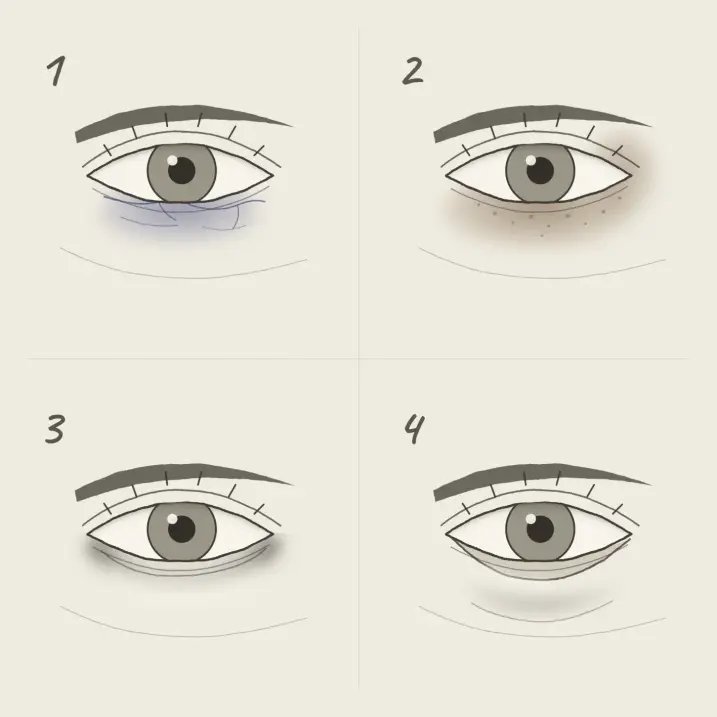
There are three main types, plus one situation that gets confused with them. Vascular dark circles look bluish or purple because the eyelid skin is very thin and lets the color of the blood vessels show through. Pigmented dark circles look brown and are due to excess melanin. Structural dark circles have no color of their own: they are a shadow cast by the hollow of the tear trough when volume is lost. And what many people call a dark circle is actually an eye bag, that is, orbital fat that bulges forward and that no cream or filler corrects.
That is why the honest answer to the question is this: mild pigmented dark circles can become almost imperceptible, structural dark circles can be corrected in a single filler session, an eye bag needs surgery to disappear, and hereditary vascular dark circles improve but rarely fade completely. Most patients have mixed dark circles, and in that case the result depends on treating each component separately and in the right order.
What causes dark circles?
The skin of the lower eyelid is the thinnest on the body, around half a millimeter. Beneath it there is very little cushioning fat and a dense network of veins. Any change in circulation, pigmentation or volume in the area becomes visible immediately, whereas on the rest of the face it would go unnoticed.
From there, several factors add up:
- Genetics and skin phototype. This is the factor that weighs most. Hereditary dark circles appear early, sometimes in adolescence, and are the most resistant.
- Age. Over the years, deep fat is lost in the cheek and bone is resorbed at the orbital rim, so the tear trough becomes more marked even if the skin stays the same.
- Lack of sleep, alcohol and salt. They do not create dark circles, but they make existing ones much worse because they increase venous congestion and fluid retention.
- Allergies and rubbing your eyes. Repeated friction causes pigmentation through inflammation, one of the most common causes of acquired brown dark circles.
- Unprotected sun exposure. It stimulates melanin right in the area where it is hardest to hide.
- Smoking. It damages the collagen in the eyelid and thins the skin even further.
How to tell which type of dark circles you have in 30 seconds
These three checks in front of the mirror, in natural light and without makeup, give a fairly good indication before any consultation:
- Stretch the skin. Place your finger under the dark circle and gently pull toward the cheekbone. If the color disappears, it is vascular. If the color remains, it is pigmented.
- Change the light. Hold a flashlight just below your eye, pointing upward. If the dark patch disappears when lit from below, it was a shadow, so it is structural.
- Lie down for five minutes. If the puffiness has gone down when you get up, there is a fluid retention component. If the bulge stays the same while you are lying down, it is a fat bag and not a dark circle.
If you do all three tests and see signs of more than one type, you have mixed dark circles. This is the most common situation from age 35 onward and explains why a treatment only half works for many people: they are treating just one of the two problems.
Which treatment matches each type?
| Tipo de ojera | Qué la causa | Qué la mejora de verdad | Cuándo se ve |
|---|---|---|---|
| Vascular | Very thin skin that lets the blood vessels show through and poor venous return | Treatments that thicken and densify the eyelid skin, vascular laser with eye protection | Gradual, between 4 and 12 weeks |
| Pigmented | Excess melanin, heredity, darker skin phototype or pigmentation after friction or dermatitis | Prescribed topical depigmenting agents, depigmenting peel, daily sun protection | Between 8 and 16 weeks |
| Structural | Volume loss in the tear trough and resorption of the orbital bone | Filler with hyaluronic acid specific to the periocular area | Immediate, settles in 2 to 3 weeks |
| With eye bag or excess skin | Herniation of the orbital fat and laxity of the lower eyelid skin | Lower blepharoplasty, with fat repositioning when appropriate | Defined at 4 to 6 weeks |
Each case explained: types of dark circles
1. Vascular dark circles
The goal is not to lighten anything, but to stop the skin from being see-through. This is done with biostimulation and substances that increase the dermal density of the eyelid, and in specific cases with vascular laser using internal eye shields. Creams with caffeine or vitamin K have a real but small and temporary effect: they reduce congestion for a few hours, they do not change the thickness of the skin. They work as maintenance, not as treatment.
2. Pigmented dark circles
They respond well to a depigmenting protocol prescribed by a doctor, combining topical active ingredients with a depigmenting peel adapted to the periocular area, which is much more delicate than the rest of the face. Two conditions make the difference between it working or not: sun protection every day of the year, and removing the cause of the friction if there is an allergy or dermatitis. Without that, the pigmentation comes back.
3. Structural dark circles
This is the type that gives the best result and the most rewarding to treat, because the shadow disappears as soon as the lost volume is restored. It is treated with hyaluronic acid specific to the tear trough, a different material from the one used in lips or cheeks: more fluid, less hydrophilic and placed in a deep plane. This is tear trough filler, and it has two advantages worth knowing. The first is that the result is visible the same day. The second is that it is reversible: if you are not happy with the result or there is excess volume, hyaluronidase dissolves the product.
It also has a clear limit that is rarely explained. If there is an eye bag underneath, filling the tear trough can make it even more noticeable, because the hollow is leveled but the bulge is still there. In those cases the indication changes.
4. Fat bag or excess skin
When what protrudes is herniated orbital fat, no cream, filler or device is going to remove it, because the problem is not in the skin but beneath it. The solution is lower blepharoplasty (eyelid surgery). When the skin is in good condition and there is only a bag, it can be done from inside the eyelid, with no visible scar, and in many cases the fat is not removed but repositioned to fill the tear trough, resolving the eye bag and the structural dark circle in the same step. If there is also excess skin, the approach is made just below the lashes and the scar is hidden in the natural crease.
It is the only one of the four options that gives a result lasting years rather than months.
What does not work and why is it still recommended?
- Cucumber slices and cold tea bags. Cold reduces congestion for a while, just like a cold spoon. There is nothing more to it.
- Color correctors as a treatment. They conceal very well, especially pigmented dark circles, but they do not change the dark circle itself. They are cosmetics, not medicine.
- Creams for structural dark circles. No cream can fill an anatomical hollow or replace bone.
- Hyaluronic acid in inexperienced hands in this specific area. Placed incorrectly or too superficially, it causes the Tyndall effect, a bluish discoloration that worsens the very problem you came to solve, as well as persistent swelling.
- Sleeping more. It helps with congestion, but genetic dark circles are not corrected by sleeping eight hours.
When dark circles are not a cosmetic issue
There are situations in which something else should be ruled out first: dark circles that appear suddenly within a few weeks with no change in habits, dark circles that affect only one eye, or dark circles accompanied by intense itching, marked morning swelling or significant tiredness. Anemia, thyroid disorders, chronic allergy and some kidney problems can show up this way. In those cases the first step is a general medical assessment, not a cosmetic treatment.
Where you can have it done
We perform tear trough filler at both of our centers. For each one you can see the price, the team that will treat you and real cases of patients from that city.

Frequently asked questions
How do you get rid of dark circles?
They only disappear completely when the cause can be fully corrected: purely structural dark circles treated with filler, or an eye bag treated with blepharoplasty. With vascular and pigmented dark circles, the realistic goal is a noticeable improvement, so that the dark circles are no longer the first thing people see on your face, followed by maintenance.
How long does it take to get rid of dark circles?
It depends on the type. Tear trough filler is visible the same day and settles in two to three weeks. A depigmenting protocol needs between eight and sixteen weeks to show its result. Biostimulation for vascular dark circles works gradually over two to three months. After a blepharoplasty, swelling and bruising resolve in one to two weeks and the result is defined at around six weeks.
What is the best treatment for dark circles?
There is no best treatment in the abstract, and that is why so many people try things that do not work for them. The best treatment is the one that matches your type of dark circles. Applying filler to pigmented dark circles does not change the color, and applying depigmenting agents to a structural shadow changes nothing at all.
What causes dark circles under the eyes?
A combination of very thin skin on the lower eyelid with genetics, age, pigmentation and volume loss. Rest, salt, alcohol and rubbing your eyes do not create them on their own, but they visibly worsen dark circles that already existed.
Can tear trough filler be dissolved if I don't like it?
Yes. Hyaluronic acid is reversible with hyaluronidase, an enzyme that dissolves it within a few days. This is one of the reasons this material is preferred in the periocular area over other fillers that cannot be removed.
The next step
Before starting any treatment, what changes the result is the diagnosis. An in-person consultation makes it possible to see whether your dark circles are vascular, pigmented, structural or mixed, whether there is an associated eye bag and in what order each component should be treated. From there, the choice between filler, a depigmenting protocol or blepharoplasty stops being a gamble.