Medically reviewed by Dr. Cristina Cobaleda specialist in aesthetic medicine, licence no. 51612Published on 8 June 2026
Skinboosters and Biostimulators: Which to choose according to your skin
When you ask "does it matter which biostimulator they use on me?", the honest answer is no: the difference is not in the brand, it's in your skin.

When you ask "does it matter which biostimulator they use on me?", the honest answer is no: the difference is not in the brand, it's in your skin. Dr. Cristina Cobaleda, from the facial aesthetic medicine team at Instituto de Benito, explains the clinical criteria we use to choose, not the catalogue response.
What is a skinbooster and what it is not
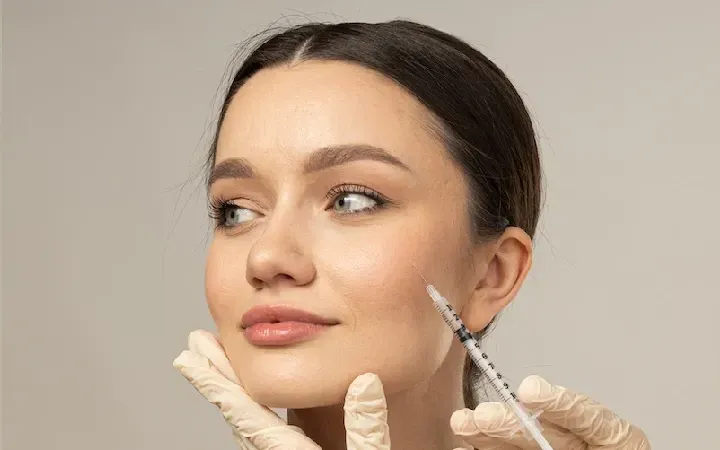
A skinbooster is an injectable of non-crosslinked hyaluronic acid (plus vitamins and antioxidants) that is microinfiltrated to hydrate the skin from within and improve its luminosity and texture. It does not add volume or correct a specific wrinkle: it works on the overall quality of the skin.
It is important to differentiate it from two things it is often confused with:
- It is not a filler. A filler uses crosslinked hyaluronic acid to create volume or project an area (lips, cheekbones, grooves). The skinbooster does not fill, it hydrates and revitalises.
- It is not botulinum toxin. The toxin relaxes the muscle to smooth expression wrinkles. The skinbooster does not act on the muscle.
And here is the nuance that almost no one clarifies: "skinbooster" and "biostimulator" are not synonyms. The skinbooster prioritises hydration; the collagen biostimulator aims for your own skin to produce new collagen (firmness and support). Some products do both in different proportions, and that is why the choice matters.
Restore Your Skin's Quality
What We Look for When Choosing a Product
Before looking at brands, we consider four variables. This is what separates a treatment that fits from one that is just "trendy".
- Type and condition of your skin. Dehydrated and dull skin does not need the same as skin with early sagging or with irregular pores and texture.
- Area to be treated. The eye contour, thin and delicate, requires a different product than the facial oval or the neck.
- Real objective. Wanting hydration and luminosity is not the same as seeking collagen stimulation (quality and regeneration) or pursuing firmness and a lifting effect on already visible sagging.
- Expected result time. Some products show results in days and others build the result progressively over weeks, in exchange for lasting much longer.
This is the key point: the correct choice does not depend on which is "the best product on the market", but on which is the best product for your combination of those four variables. That is why at Instituto de Benito the product is decided during the assessment, not before.
Product Comparison
There is no universal "winner" biostimulator. There is the one that corresponds to each objective. This table summarises how each family behaves:
| Product | Mechanism | Best for | No. of sessions* | Duration of result* |
|---|---|---|---|---|
| Skinbooster (non-crosslinked hyaluronic acid) | Deep hydration and dermis revitalisation | Dull, dehydrated skin, first fine lines | 2-3 monthly sessions | 3-6 months |
| Profhilo (hybrid HA, bioremodelling) | Bioremodels and stimulates collagen and elastin | Mild laxity, firmness of the oval and lower third | 2 sessions 4 weeks apart | 6-12 months |
| Sunekos (HA + amino acids) | Regenerates the extracellular matrix via fibroblasts | Eye contour, thin or crepey skin | 4 sessions (protocol) | ~6 months |
| Polynucleotides / PDRN | Cellular repair and regeneration | Skin quality, dark circles, sensitised skins | 3 sessions | 6-9 months |
| Polylactic acid (PLLA, like Sculptra) | Progressive and global collagen stimulation | Diffuse laxity, general loss of firmness | 2-3 sessions | Up to ~24 months |
| Calcium hydroxyapatite (like Radiesse) | Immediate tightening effect + biostimulation | Structural support and firmness in specific areas | 1-2 sessions | 12-18 months |
Real Cases in Consultation
To understand the criteria, two real patients treated by Dr Cobaleda. The context matters: it is not "which brand won", it is how each product performed in each profile.
The conclusion is not that one product is superior to another. It is that the same objective in two different skins is resolved with different products, and getting that decision right is precisely what changes the outcome.

How to know which one suits you
There is no reliable way to choose your biostimulator online, because it depends on your skin, your area and your goal, three variables that can only be assessed in person. What we can guarantee is the criterion: at Instituto de Benito the product is decided by the doctor treating you, with follow-up before and after, not a closed protocol the same for everyone.
If you want to know which treatment suits your skin, request your facial aesthetic medicine assessment with our team. We study your case and propose the plan that truly corresponds to your objective, not the best-selling one.
Related treatments at IdB
These are the treatment pages related to what you have just read. On each one you will find the price, the surgeon who performs it and real patient cases.

Skinbooster, flaunt radiant skin
The Skin Booster is a facial aesthetic medicine treatment based on microinjections of non-crosslinked high-purity hyaluronic acid.

Collagen inducers: firmer skin
Collagen inducers are medical-aesthetic treatments designed not to fill a gap immediately (as hyaluronic acid would), but to stimulate your own body to produce new collagen.
Frequently Asked Questions
What is the difference between a skinbooster and a biostimulator?
The skinbooster provides deep hydration and improves skin quality thanks to low cross-linked hyaluronic acid. The biostimulator, on the other hand, stimulates the natural production of collagen and elastin to achieve firmer skin with better structure. They do not compete with each other: they have different objectives.
I am 30 years old, which one suits me better?
If your skin starts to show dehydration, loss of radiance or small fine lines, a skinbooster is usually an excellent preventive option. Biostimulators are often recommended when signs of sagging or loss of firmness appear, although the choice always depends on a personalised assessment.
Can I combine skinboosters and biostimulators?
Yes. In fact, it is a very common combination. While the skinbooster improves hydration and the superficial appearance of the skin, the biostimulator works in the deeper layers stimulating collagen. Together they offer more complete and natural results.
Does it hurt to have a skinbooster or a biostimulator?
It is a very tolerable technique. Very fine needles or cannula are used and, when necessary, anaesthetic cream is applied beforehand. Most patients describe it as small pricks, not as a painful treatment. There may be slight redness or small papules that are reabsorbed within hours or a few days.
How often should the treatment be repeated?
It depends on the product used and the condition of the skin. A skinbooster is usually planned in 2 or 3 initial sessions with maintenance every six months. Some collagen biostimulators offer results that can last up to two years. The schedule is always adapted to each patient.
Are the results noticeable immediately?
Skinboosters usually provide a feeling of hydration and radiance in the first few days. Biostimulators need several weeks to stimulate the formation of new collagen, so the result appears progressively and very naturally.
Profhilo or Sunekos: which is better?
Neither is universally better, as they address different needs. Profhilo is aimed at improving skin firmness and bioremodelling, while Sunekos excels in regenerating delicate areas such as the eye contour. In many patients, both treatments can be combined.
Are they effective for eliminating deep wrinkles?
They are not designed to fill pronounced grooves like a structural hyaluronic acid filler. Their function is to improve skin quality, hydration, and firmness, making fine lines less noticeable and giving the face a healthier appearance.
From what age are they recommended?
There is no specific age. Some people start around the age of 30 to prevent skin ageing and maintain good skin quality, while others use them from their 40s or 50s to address the loss of firmness and elasticity.
Can I resume normal activities after the treatment?
Yes. Most patients return to their routine the same day. It is recommended to avoid intense exercise, saunas, swimming pools, and significant sun exposure during the first 24-48 hours to promote proper recovery.
Do these treatments change facial expression?
No. When properly indicated, they do not alter features or give an artificial appearance. Their aim is to improve skin quality and stimulate natural regeneration processes, achieving a fresh and subtle result.
Can they be applied to areas other than the face?
Yes. They are also frequently used on the neck, décolletage, and hands, areas where the skin loses hydration and elasticity over time and where signs of ageing often become visible.