Medically reviewed by Dr. Álvaro Chaux specialist in aesthetic medicine, licence no. 61405Published on 1 June 2026
Types of Wrinkles: Dynamic, Static and Gravitational
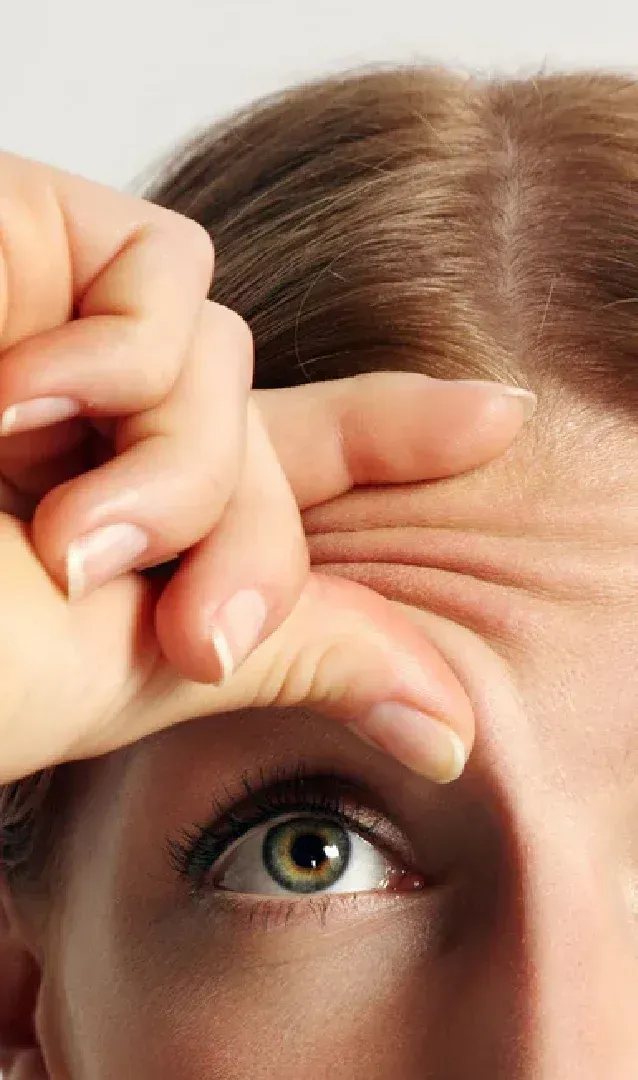
Wrinkles are classified into three types according to their origin. Dynamic wrinkles appear only when making facial expressions and disappear at rest

Wrinkles are classified into three types according to their origin. Dynamic wrinkles appear only when making facial expressions and disappear at rest: they include forehead lines, frown lines and crow's feet, and are caused by repeated muscle contraction. Static wrinkles are already visible with a relaxed face and are due to the loss of collagen, elastin and volume. Gravitational wrinkles are not folds but sagging of the tissue due to loss of support, and they appear from the fifth decade in nasolabial folds, marionette lines and facial oval. Identifying which type you have is the first step before any decision, because each type responds to a different approach and confusing them is the most common cause of disappointing results.
A wrinkle is not just a wrinkle. Under the same visible fold, there may be a muscle that contracts too much, a dermis that has lost collagen, or a tissue that has simply sagged. These are three distinct biological problems, and therefore the first step in any serious assessment is not to choose what to do, but to understand what is present.
In this guide, we explain how to identify each type, how to distinguish them yourself in front of the mirror, which wrinkles correspond to each area of the face and when a wrinkle changes category.
Say Goodbye to Your Wrinkles

The Three Types of Wrinkles
Dynamic Wrinkles (or Expression Wrinkles)
They appear when moving the face—smiling, frowning, raising the eyebrows—and disappear when the muscles relax.
Their origin is purely muscular: each gesture folds the skin in the same direction, thousands of times a day. As long as the dermis retains elasticity, the fold disappears on its own. They are the first to appear, usually from the age of 25-30, and are concentrated in the upper third of the face.
Where: forehead (horizontal lines), frown or glabellar area (vertical "anger" lines), eye contour (crow's feet), nasal bridge (bunny lines).
Static Wrinkles
They are visible at rest, without making facial expressions. The skin no longer returns to its position.
Their origin is structural: progressive loss of type I and III collagen, degradation of elastin fibres and decrease of hyaluronic acid in the dermis. The skin loses its ability to recover and the fold becomes marked. It is accelerated by photoageing, smoking and sugar-associated glycation.
Where: perioral lines or "barcode", cheek wrinkles, periorbital wrinkles at rest, neck (the so-called "Venus rings").
Gravitational Wrinkles
Strictly speaking, they are not wrinkles, they are sagging. The tissue loses support and falls, creating grooves and folds.
Three simultaneous factors are involved: resorption of facial bone, atrophy and displacement of deep fat pads, and laxity of the superficial musculoaponeurotic system. Therefore, directly filling the groove without correcting the loss of support usually gives unnatural results: it treats the symptom instead of the cause.
Where: deep nasolabial folds, marionette lines, loss of definition of the facial oval, sagging of the midface.
A Fourth Group: Mixed Wrinkles
In clinical practice, the most common scenario from the age of 40 is not a pure type, but the overlap of all three. A frown line may have a dynamic component (the muscle) and a static component (the already etched line), requiring a two-step approach.
And a Special Case: Sleep Wrinkles
They are formed by the mechanical pressure of the pillow when sleeping on your side or stomach, not by making facial expressions or due to age. They are recognised because they are asymmetrical: they appear only on the side you sleep on, and are usually vertical or oblique on the cheek and décolletage. They do not respond to botulinum toxin because there is no muscle contraction involved. Sleeping on your back and using silk pillowcases helps prevent them.
Comparative Table: How to Distinguish Them
| Dynamic | Static | Gravitational | |
|---|---|---|---|
| Visible at rest? | No | Yes | Yes |
| Accentuated by facial expressions? | Yes, a lot | Slightly | No |
| Cause | Repeated muscle contraction | Loss of collagen and elastin | Loss of bone, fat and ligament support |
| Typical age of appearance | 25-35 years | 35-50 years | From 50 onwards |
| Most common areas | Forehead, frown lines, crow's feet | Perioral, cheeks, neck | Nasolabial, marionette, oval |
| Corrected by acting on | The muscle | The dermis and volume | The structure and support |
| Can they be prevented? | Partially | Yes, with photoprotection and habits | Little: they depend on structural ageing |
How to Know What Type of Wrinkle You Have: The Mirror Test
Three steps, one minute, natural light and no makeup:
- Completely relax your face and look straight ahead. Everything you still see is static or gravitational. What has disappeared was dynamic.
- Make facial expressions: raise your eyebrows, frown, smile forcefully. The lines that appear now and were not there before are purely dynamic. Those that were already there and now become more pronounced are mixed.
- Lie on your back or gently stretch the skin of your cheek upwards and backwards. If the groove improves significantly with that gesture, there is a gravitational component: it is not a problem of the line, it is of support.
An additional sign: if the wrinkle is asymmetrical, marked only on one side, suspect a sleep wrinkle or a lateralised gesticulation pattern.
This test guides the type of wrinkle, it does not replace an assessment. In consultation, we also need to evaluate dermal thickness, collagen quality and real muscle dynamics, because two people with the same line on the glabella may need very different things.
— Dr. Álvaro Chaux, specialist in aesthetic medicine
Wrinkles by facial area: name by name
Each area has its nomenclature, its responsible muscle and its predominant type.
| Area | Common name | Predominant type | Involved muscle or cause |
|---|---|---|---|
| Forehead | Horizontal lines, "worry lines" | Dynamic | Frontal muscle |
| Glabella | Glabellar lines, "frown lines", the "11" | Dynamic, then mixed | Corrugator and procerus |
| Eye contour | Crow's feet | Dynamic, then mixed | Orbicularis oculi |
| Nasal bridge | Bunny lines, rabbit wrinkles | Dynamic | Nasal |
| Nasogenian groove | Nasolabial fold | Gravitational | Descent of the malar fat compartment |
| Corners towards the chin | Marionette lines | Gravitational | Loss of support and depressor anguli oris |
| Upper lip | Perioral lines, "barcode" | Static | Orbicularis oris + photoageing |
| Chin | Orange peel skin, cobblestone | Dynamic | Mentalis |
| Neck | Venus rings or platysmal bands | Static and gravitational | Platysma and loss of elasticity |
| Décolletage | Vertical lines | Static (and sleep-related) | Photoageing and sleeping posture |
When a dynamic wrinkle becomes static
It is the most important turning point of the entire guide, and explains why the timing of intervention affects the outcome.
The process has three phases:
- Reversible phase. The muscle folds the skin when making expressions. The dermis, with collagen and elastin in good condition, fully recovers its position at rest.
- Transition phase. Repeated folding along the same line generates microdamage in the dermal fibres. Simultaneously, collagen production progressively decreases from the age of 25. The skin starts to recover less effectively.
- Established phase. The line becomes engraved. The fold is now visible at rest, and from there, acting only on the muscle will not erase it, because the problem is no longer exclusively muscular.
The practical consequence: a dynamic wrinkle is much more manageable than the same wrinkle five years later turned static. This is why in aesthetic medicine we talk about prevention and not just correction.
Why they appear: intrinsic and extrinsic ageing
Two clocks act on the same face at once.
- Intrinsic ageing (chronological). It is programmed: a decrease in collagen synthesis of approximately 1% annually from the mid-twenties, reduction of dermal hyaluronic acid, bone resorption of the facial mass and redistribution of fat pads. It cannot be avoided, only accompanied.
- Extrinsic ageing. It is the one that does depend on you, and explains much of the difference between two people of the same age:
- Ultraviolet radiation. The most important extrinsic factor by far. It degrades collagen and elastin, and is responsible for most fine wrinkles and texture alterations. Daily photoprotection is the only anti-ageing measure with solid evidence in prevention.
- Tobacco. It reduces oxygen supply to the dermis and activates enzymes that degrade collagen. Additionally, the repeated gesture of smoking marks the perioral lines.
- Glycation. Excess sugar generates advanced glycation end products that stiffen collagen fibres and reduce their recovery capacity.
- Sleeping posture and pollution, with a lesser but measurable impact.

The Glogau scale: how photoageing is classified
In consultation, we not only classify the wrinkle, but also the overall stage of the skin. The Glogau scale is the classic reference and places each patient in one of four groups:
| Type | Description | Indicative age | What is observed |
|---|---|---|---|
| 1 | No wrinkles | 28-35 years | Early photoageing, mild pigmentary changes, no wrinkles at rest |
| 2 | Wrinkles in motion | 35-50 years | Lentigines, expression lines visible when gesticulating, palpable but not visible keratoses |
| 3 | Wrinkles at rest | 50-65 years | Dyschromias, telangiectasias, visible keratoses, wrinkles present with a relaxed face |
| 4 | Only wrinkles | 60-75 years | Yellow-greyish tone, wrinkles all over the face, no areas of intact skin |
What can be done with each type
Each type of wrinkle responds to a different family of procedures. This is the general map; the details of each option, indications, duration and contraindications are developed on our anti-wrinkle treatment page.
| Type of wrinkle | What to act on | Family of options |
|---|---|---|
| Dynamic | The muscle | Botulinum toxin (anti-wrinkle treatment) |
| Static | The dermis and lost volume | Hyaluronic acid, collagen inducers, peels, fractional laser |
| Gravitational | The structural support | Thread lifts, Ultherapy, volume replacement, facelift in advanced cases |
| Mixed | Two or three fronts at once | Sequenced combination, defined in assessment |
| Sleep | The mechanical cause | Change of posture, silk pillowcases, bio-stimulation of the area |
Related treatments at IdB
These are the treatment pages related to what you have just read. On each one you will find the price, the surgeon who performs it and real patient cases.
Expression Wrinkle Treatment
The wrinkle treatment at Instituto de Benito is a medical-aesthetic procedure based on a medical treatment that temporarily relaxes the muscles responsible for dynamic expression wrinkles

Skinbooster, flaunt radiant skin
The Skin Booster is a facial aesthetic medicine treatment based on microinjections of non-crosslinked high-purity hyaluronic acid.
Frequently asked questions about wrinkle treatments
What is the difference between a dynamic and a static wrinkle?
The dynamic wrinkle is only visible when making facial expressions and disappears when the face is relaxed; it is caused by repeated muscle contraction. The static wrinkle is visible at rest and is due to the loss of collagen and elastin in the dermis. An untreated dynamic wrinkle can become static over the years.
How many types of wrinkles are there?
Three main types according to their origin: dynamic or expression wrinkles, static, and gravitational. From the age of 40, mixed wrinkles, which combine several components, are the most common. A particular case is also described, sleep wrinkles, caused by pillow pressure.
Are frown lines dynamic or static?
They start as dynamic: caused by the contraction of the corrugator muscle when frowning. Over the years, repeated folding turns them into mixed and finally static, visible with the face completely relaxed.
What are gravitational wrinkles?
They are not skin folds but a consequence of facial tissue sagging. As bone, fat, and ligament support is lost, the tissue descends and forms grooves: deep nasolabial folds, marionette lines, and loss of oval definition. They appear mainly after the age of 50.
Why do I have wrinkles only on one side of my face?
The most common cause is sleep wrinkles, formed by the pressure of the pillow when always sleeping on the same side. It can also be due to an asymmetrical pattern of facial expressions or uneven sun exposure, common in those who drive a lot.
At what age do wrinkles start to appear?
Dynamic wrinkles usually appear between the ages of 25 and 35, coinciding with the onset of collagen production decline. Static wrinkles become evident between the ages of 35 and 50, and gravitational wrinkles from the fifth decade. Accumulated sun exposure can advance the whole process by several years.
Can wrinkles be prevented?
Not completely, as there is an inevitable chronological component. However, their appearance can be significantly delayed: daily photoprotection is the measure with the most evidence, followed by not smoking, controlling dietary sugar, and maintaining a cosmetic routine with proven effective ingredients.
What is the Glogau scale?
It is a clinical classification of skin photoaging into four types, from I (no wrinkles, with mild pigmentary changes) to IV (wrinkles all over the face). It allows for assessing the overall stage of the skin and adjusting expectations before considering any procedure.
Are neck wrinkles different from facial wrinkles?
Yes. The skin on the neck is thinner, has fewer sebaceous glands and less structural support, so it ages earlier and differently. The horizontal lines (Venus rings) have a static component, and the vertical platysma bands are mainly gravitational.
Can a static wrinkle become dynamic again?
No. The process is unidirectional: a dynamic wrinkle can become established and turn static, but a wrinkle already etched in the dermis does not revert on its own. This is why the timing of intervention greatly influences the outcome.