Medically reviewed by Dr. Marina García, licence no. 19091Published on 26 October 2026
Tuberous breast grades: how to tell which one you have and what surgery each needs
Tuberous breasts are classified into four grades according to how much of the breast base failed to develop. In grade I it is mainly the lower inner area that is missing, in grade II the whole lower half and in grade III the entire base. Grade IV is the most severe form. The grade guides the surgery, but each breast is assessed separately.
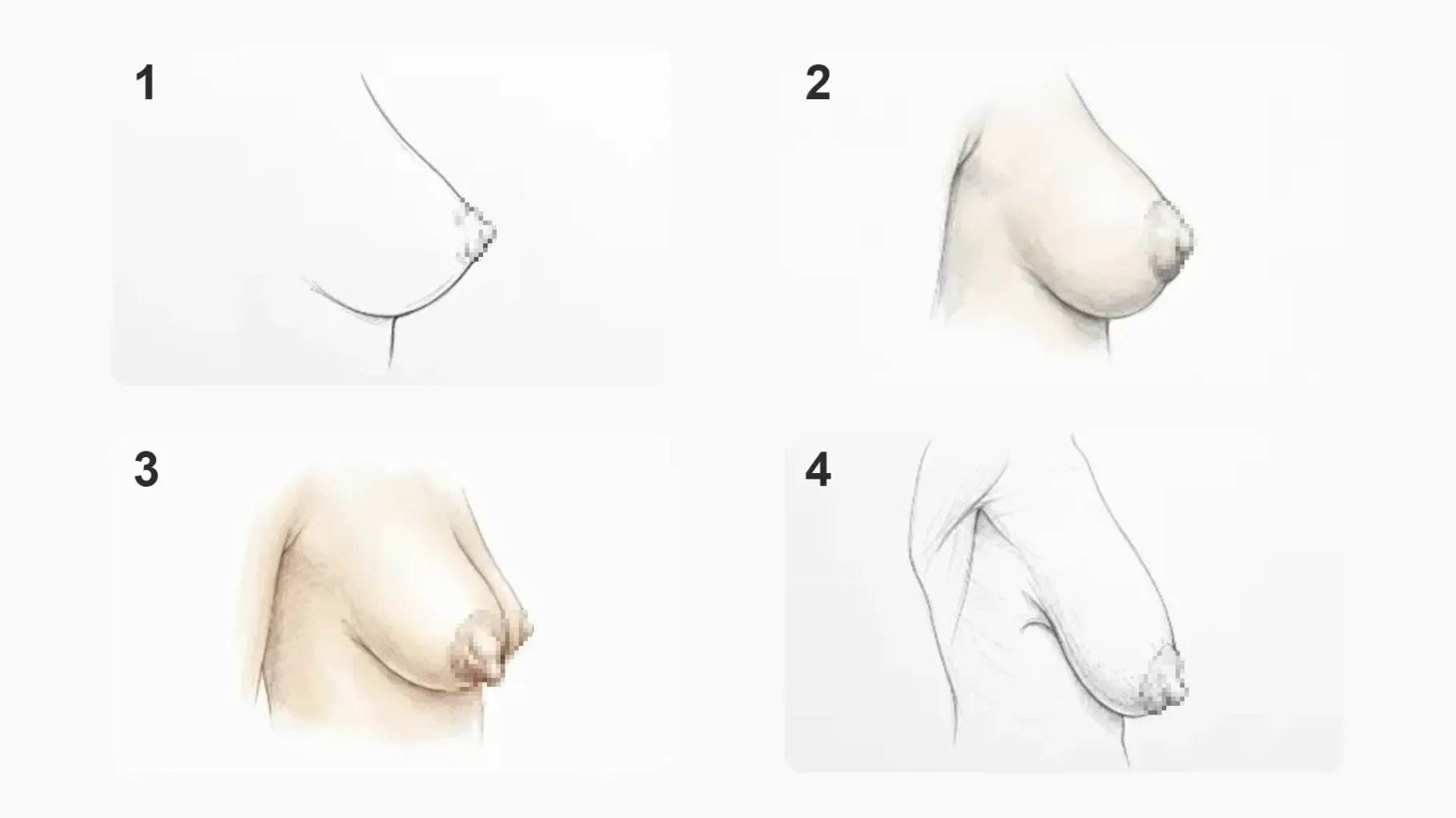
Putting a number on a tuberous breast has a practical purpose: anticipating what needs to be done in the operating room. A grade I and a grade III share the name and little else, which is why two patients with the same diagnosis can be given very different plans.
Your tuberous breast correction starts here

How do I know if I have tuberous breasts?
It is a congenital condition that becomes visible at puberty, when the breast grows. At the base of the breast there is a ring of fibrous tissue that constricts it, so instead of expanding downwards and outwards, the breast grows forwards. That is what gives it its elongated or tube-like shape.
These are the most common signs:
- The base of the breast, the part that sits on the chest wall, is narrow.
- The fold under the breast sits higher than normal and the distance between the areola and that fold is short.
- The areola is large or looks puffy, as if the tissue were pushing outwards.
- There is a wider gap than usual between the two breasts.
- One breast is different from the other, in size or in shape.
You do not need to have all of them. A small or sagging breast is not tuberous for that reason alone: what defines it is the narrow base and the short lower pole. Confirmation comes with a physical examination, because a mild grade is easily mistaken for an underdeveloped breast.
The four grades, one by one
The classification divides the breast into four quadrants and looks at how many are affected. The more that are missing, the more tubular the shape and the more complex the correction.
Grade I
It mainly affects the lower inner part. The base is somewhat narrow, the shape barely elongated and the areola may be slightly puffy. Asymmetry is usually mild. Many women with grade I do not know they have it until they hear it in a breast augmentation consultation.
Grade II
The deficit extends to the whole lower half, both inner and outer. The tube-like shape is noticeable, the breasts sit further apart and the areola tends to be more dilated or prominent. This is where skin starts to be short in the lower pole, and that matters when planning.
Grade III
The base is underdeveloped in all four quadrants. The breast has a clearly tubular shape, little volume and marked herniation of the areola. A significant difference between the two sides is common.
Grade IV
This is the most severe form: the constriction of the base is strong, the tissue is very underdeveloped and the areola is highly herniated. The whole shape of the breast is altered, and the correction is complex.
Why do some sources talk about three grades and others about four?
Because there is more than one classification. Some group cases into three types and others, like the one we use at Instituto de Benito, separate four grades. The substance does not change: they all rank cases from mild to severe according to how much of the base is missing. If one clinic tells you grade III and another type 3, it is worth asking which scale they are using.

What surgery does each grade need?
In every grade the root of the problem is the same: the fibrous ring that constricts the breast. So whatever the grade, surgery releases that ring and redistributes the tissue to widen and round out the base. What changes is what needs to be added:
- In mild grades, reshaping the breast's own tissue and lowering the fold is sometimes enough. If volume is lacking, an implant is added.
- When the areola is herniated or dilated, its diameter is reduced in the same operation, with a scar around the areola.
- If the breast has also dropped, it is combined with a breast lift to raise it.
- In a grade III with little skin in the lower pole, forcing everything into a single operation puts the result at risk. A safe correction may need two stages: first expanding the skin or adding the patient's own fat over several sessions, and then placing the definitive implant.
Implants are not always needed. They are decided according to the volume of each breast and the shape you are looking for, never by the grade alone.
In this video, Dr. Marina García goes over with Irene, three weeks after her surgery, what was done: an implant and a periareolar breast lift, with the scar only around the areola.
Can they be corrected without surgery?
No. The fibrous ring and the high fold are part of the structure of the breast, and neither exercise, creams nor bras change them. What a garment can do is disguise the shape under clothes. The patient's own fat, when used to add volume, is also applied in the operating room.
Who assesses it at Instituto de Benito?
In Barcelona, Dr. Marina García. In Madrid, Dr. Lucrecia Villanueva. Both of them assess in consultation the grade of each breast, skin quality, volume and asymmetry, and they then perform your surgery. The surgery page shows real cases from both clinics.
The first visit costs €80 and is deducted from the surgery if you decide to go ahead. If you cannot come in person, it can be done by video call with the surgeon who would operate on you, for €50.
Frequently asked questions about tuberous breast grades
Can each breast have a different grade?
Yes, and it is the norm. Tuberous breasts are asymmetrical in most cases, and it is not unusual to find grade I on one side and grade II or III on the other. That is why each breast is planned separately.
The aim is to improve the shape significantly. Absolute symmetry cannot be promised, and anyone who would not accept a small residual difference or the possibility of a touch-up should know this before surgery.
How much does tuberous breast surgery cost?
Correction starts at €6,500 at Instituto de Benito and increases with the grade, the technique and the operating time. Everything the price includes is explained on the tuberous breast surgery page. If the case needs two stages, it is quoted that way from the start.
Will I be able to breastfeed afterwards?
In most cases, yes: current techniques are designed to preserve the gland and the ducts. Each case is assessed in consultation. If you are planning a pregnancy soon, we recommend waiting until afterwards, because pregnancy changes the volume and skin of a breast that has been reshaped.