11 May 2026
The surgeon of Michael Jackson who trained Dr. de Benito
Get the peel that was born in Hollywood

In short: Dr. Steven Hoefflin, a plastic surgeon from Santa Monica, operated on Michael Jackson and Sylvester Stallone
In short: Dr. Steven Hoefflin, a plastic surgeon from Santa Monica, operated on Michael Jackson and Sylvester Stallone. Dr. de Benito trained for three weeks in his clinic and brought to Spain two practices that were then pioneering: individualized informed consent and the modern classification of chemical peels. This training continues to influence the work of Instituto de Benito today.
The release of the new movie about Michael Jackson has once again put names and faces from the artist's medical circle in the spotlight. Among them is Dr. Steven M. Hoefflin, a plastic surgeon in Santa Monica (Los Angeles) and one of the most recognized figures in 20th-century aesthetic surgery. What few patients of Instituto de Benito know is that Dr. de Benito trained directly in his operating room.
Who was Dr. Steven Hoefflin
Dr. Steven Hoefflin operated in Santa Monica, California, and was considered one of the most influential plastic surgeons of his generation. He treated figures like Michael Jackson and Sylvester Stallone, but his technical authority went far beyond his Hollywood office: he was a reference for European surgeons who wanted to stay updated.
His clinic was not a medical tourist destination. It was an operating room where procedures were being defined, from rhinoplasty techniques to chemical peel protocols that would later be taught at major international congresses.
Three weeks in Santa Monica: the training of Dr. de Benito
Dr. de Benito spent three full weeks at Dr. Hoefflin's clinic, attending his daily surgical practice, observing his case-by-case criteria, and his way of coordinating the team. It was not a protocol visit: it was a work stay in one of the most recognized operating rooms in the world.
From that experience, the team that today leads Instituto de Benito did not take away just one technique. They took away a complete way of understanding plastic surgery that was going to change the way the clinic operated in Spain.
Instituto de Benito, one of the first teams in Spain with individualized informed consent
One of Dr. Hoefflin's most advanced practices, which is now an international standard, was individualized informed consent: a specific document for each patient and each intervention, explaining risks, alternatives, and expected results before entering the operating room. At the time of Dr. de Benito's stay, this practice was not common in Europe.
Upon his return, he incorporated it into the team's protocol. Instituto de Benito was one of the first teams in Spain to operate with specific informed consents for each plastic surgery, drafted patient by patient and procedure by procedure. It is one of the most solid clinical legacies of that stay and remains part of the clinic's protocol today.
The classification of chemical peels was born in his clinic
Key fact: Dr. Steven Hoefflin was the first in the world to describe the modern classification of chemical peels: superficial (light), medium, and deep (strong) peel.
Hoefflin was not only a reference in the operating room. He was also one of the world's leading experts in acid peels and authored the classification that appears in any aesthetic medicine manual today:
- Superficial peel (light): acts on the epidermis. Indicated for texture, brightness, and mild spots.
- Medium peel: reaches the papillary dermis. Indicated for fine wrinkles, moderate sun damage, and dyschromias.
- Deep peel (strong): reaches the reticular dermis. Indicated for marked wrinkles, scars, and advanced photoaging.
This classification, now universal, originates from Hoefflin's clinical work. For the Instituto de Benito team, trained directly with him, it is not just textbook theory: it is the decision-making tool used every week in consultations to choose the appropriate depth for each skin type and aesthetic goal.
A photograph, a clinical legacy
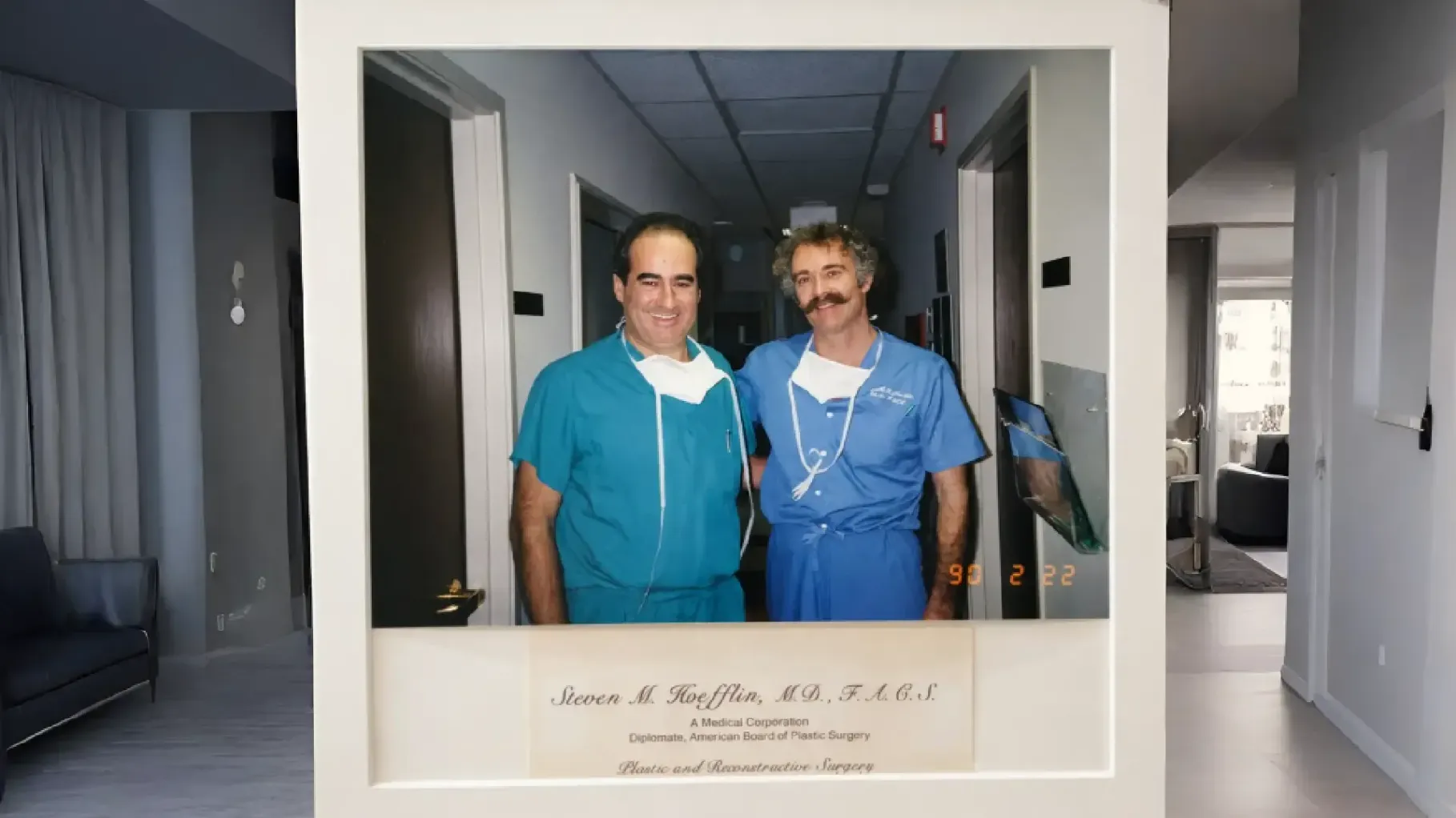
From that stay, Dr. de Benito keeps, among other memories, a photograph with Dr. Hoefflin taken at his Santa Monica clinic. But what is truly important is not the image: it is what he brought to Spain and continues to define the team's work: documenting each case rigorously, explaining each risk to the patient before operating, and applying the precise technique, neither more invasive nor less, for each anatomy.
Plastic surgery advances when teams train abroad, bring back what they have learned, and adapt it to their clinical reality. Part of what is today Instituto de Benito was also built in Santa Monica, in the clinic of the surgeon who shaped some of the most famous faces of the 20th century.
Frequently Asked Questions
Who was Dr. Steven Hoefflin?
Steven M. Hoefflin was an American plastic surgeon with a practice in Santa Monica, California. He is considered one of the most influential figures in 20th-century plastic surgery, and his patients included Michael Jackson and Sylvester Stallone.
Who operated on Michael Jackson?
Dr. Steven Hoefflin was for years the go-to plastic surgeon for Michael Jackson. He operated in Santa Monica (Los Angeles, California) and regularly treated Hollywood celebrities.
Where did Dr. de Benito train?
Dr. de Benito trained in plastic surgery in Spain and completed his training with international stays, including three weeks at Dr. Steven Hoefflin's clinic in Santa Monica, California, one of the most recognized plastic surgeons in the world.
How many types of chemical peels are there?
There are three main types of chemical peels based on the depth of action on the skin: superficial (light), medium, and deep (strong). This classification was first described worldwide by Dr. Steven Hoefflin and is the one used today in aesthetic medicine.
Which chemical peel is most suitable for me?
The choice depends on the skin type, degree of photoaging, spots, wrinkles, and aesthetic goal. At Instituto de Benito, the decision is always made after an in-person evaluation: the superficial peel is indicated to improve texture and brightness, the medium for fine wrinkles and spots, and the deep for marked wrinkles or advanced sun damage.
What is informed consent in plastic surgery?
Informed consent is an individualized document in which the surgeon explains to the patient, before the intervention, what the surgery consists of, what risks it has, what alternatives exist, and what results can be expected. Instituto de Benito was one of the first teams in Spain to apply it systematically, a practice that Dr. de Benito incorporated after his training with Dr. Hoefflin.