Medically reviewed by Dr. Orestes Fernández specialist in body contouring, licence no. 4304469Published on 16 April 2026
Butt augmentation: implants or your own fat (BBL), which should you choose?
Butt augmentation has been one of the most requested cosmetic surgeries in recent years. However, it is also one of the most misunderstood.

Butt augmentation can be performed with implants or with your own fat (BBL). This post helps you understand what each technique involves, their real differences, advantages, risks and which option suits you best based on your anatomy and goals. It is aimed at patients who value a balanced, safe result and want to make an informed decision before a first consultation.
What is butt augmentation with implants?
Augmentation with butt implants involves placing solid silicone implants specifically designed for this area. They are inserted through an incision in the intergluteal crease, which hides the scar to a large extent.
There are two main placement planes: intramuscular (within the gluteus maximus muscle) and subfascial (above the muscle). The intramuscular technique is the most widely used because of its balance between a natural look and a lower risk of displacement. The implants come in anatomical or round shapes and are highly cohesive to withstand pressure and movement. The main benefit is that the volume achieved is stable and predictable, regardless of weight changes.
It is an option particularly suited to very slim patients or those without enough fat for a BBL. The trade-off is that you have to accept a scar and the fact that the implants may need replacing over time.
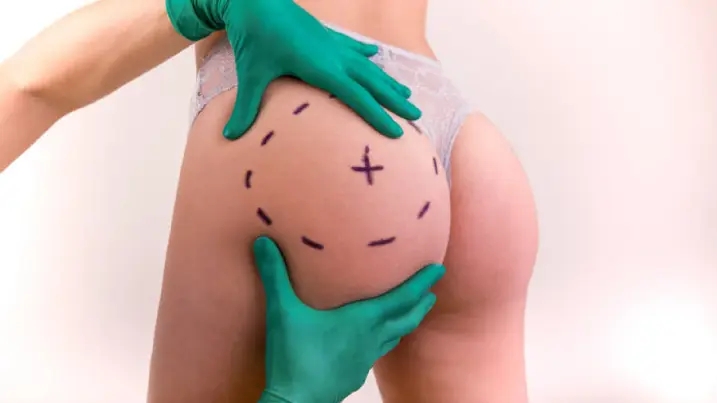
What is a BBL or buttock fat transfer?
The BBL (Brazilian Butt Lift) uses the patient's own fat to enlarge and shape the buttocks. The procedure is divided into three stages:
- Harvesting: liposuction is performed on areas such as the abdomen, flanks or lower back.
- Processing: the fat is purified to isolate the viable cells.
- Injection: it is strategically injected into the buttocks to add volume and shape.
The great advantage is that it combines two benefits: butt augmentation and body contouring (a “more defined waist” effect). The result usually looks and feels more natural. - Dr. Orestes
However, not all of the fat survives: between 30% and 50% is reabsorbed, which introduces some variability in the final result. In some cases a second session is recommended to optimize volume.
Comparison table: implants vs BBL
| Implantes glúteos | BBL (grasa propia) | |
|---|---|---|
| Achievable volume | High and predictable | Limited by the donor fat available |
| How it feels to the touch | Firm | Natural (it is your own tissue) |
| Reabsorption | 0% | 30-50% (in the first 3-6 months) |
| Scar | Visible (intergluteal incision) | Minimal (3-5 mm from the cannulas) |
| Additional effect | Augmentation only | Liposculpture of the waist/lower back |
| Anesthesia | General | General |
| Length of surgery | 1-2 hours | 3-5 hours |
| Social downtime | 14-21 days | 21-28 days |
| No sitting directly | 2-3 weeks | 4-6 weeks |
| Future changes | Replacement at 10-15 years | Possible 2nd session for more volume |
| Specific risks | Contracture, displacement, extrusion | Fat embolism (if the technique is incorrect) |
Which one is right for you?
The choice depends on several factors:
- Little fat available: implants are the best option.
- You want to reshape your waist and back: a BBL gives a more all-round result.
- You are looking for maximum volume and precision: implants.
- You prioritize a natural look and a double benefit: BBL.
- Ideal case and flexible budget: a combination of both techniques.
There is no universally better option; what matters is adapting the technique to your anatomy and expectations. -Dr. Orestes
Combined technique: the best of both
The combined technique uses a moderately sized implant together with fat transfer to refine the contour. It is indicated for patients who want significant volume but also a natural finish in areas such as the hips or the upper buttock.
The implant provides projection and structure, while the fat softens the transitions and improves the overall shape. The result is usually more balanced than with a single technique.
Recovery day by day
- First 3–5 days: swelling, discomfort controlled with medication.
- Weeks 1–2: gradual return to mobility, avoid direct pressure on the buttocks.
- Weeks 2–3: return to light social activities (sooner with implants than with a BBL).
- Weeks 3–6: with a BBL, sitting directly is still restricted.
- Week 6+: gradual return to exercise.
- 3 months: a more stable result.
- 6 months: final result.
Following the recommendations (especially avoiding pressure) is key to the result. -Dr. Orestes
Approximate prices in Spain (
- Butt implants: €6,500 – €12,000
- BBL: €7,000 – €11,000
These include the operating room, fees, anesthesia and follow-up. Be wary of very low prices: they may mean a lack of experience, weaker safety controls or the absence of qualified doctors.
Frequently asked questions
Which is better for butt augmentation: implants or fat transfer?
There is no single right answer. The best technique depends on the patient's anatomy, the amount of fat available and the result they want to achieve.
In general, fat transfer (BBL) offers a more natural result, while implants allow greater volume and projection, especially in patients with little fat.
From a medical point of view, the key is not choosing the most popular technique but the most suitable one for each case, always prioritizing safety and a predictable result.
What are the most common risks of butt augmentation?
They depend on the technique used. With fat transfer, the main ones are fat reabsorption and asymmetries, while with implants capsular contracture or displacement are more frequent.
Why is there so much talk about the risks of a BBL?
Because it is a technique that has evolved a great deal in recent years and requires very precise execution. The leading scientific societies, such as the American Society of Plastic Surgeons and the International Society of Aesthetic Plastic Surgery, have stressed the importance of applying safe techniques and selecting patients correctly.
Can the risk of a buttock fat transfer be reduced?
Yes. By using appropriate techniques, avoiding deep planes and having the procedure performed in accredited centers by specialized surgeons, the risk is significantly reduced.
Are butt implants safer than a BBL?
Not necessarily. Although they avoid certain risks of a BBL, implants have their own complications, such as infections or capsular contracture.
What is the most common complication of a BBL?
The most common is partial reabsorption of the transferred fat, which can affect the final volume and require touch-ups.
Can the result look uneven?
Yes, especially with fat transfer, where the fat may not integrate completely evenly. That is why technique and the surgeon's experience are key.
How do I know if I'm a good candidate so I can avoid risks?
A personalized medical consultation is essential. Factors such as your anatomy, skin quality and expectations will determine which technique is safest in your case.