Medically reviewed by Dr. Víctor Cabrera Mas, licence no. 50169 Published on 13 November 2026
Rippling after breast augmentation: what it is and how to fix it
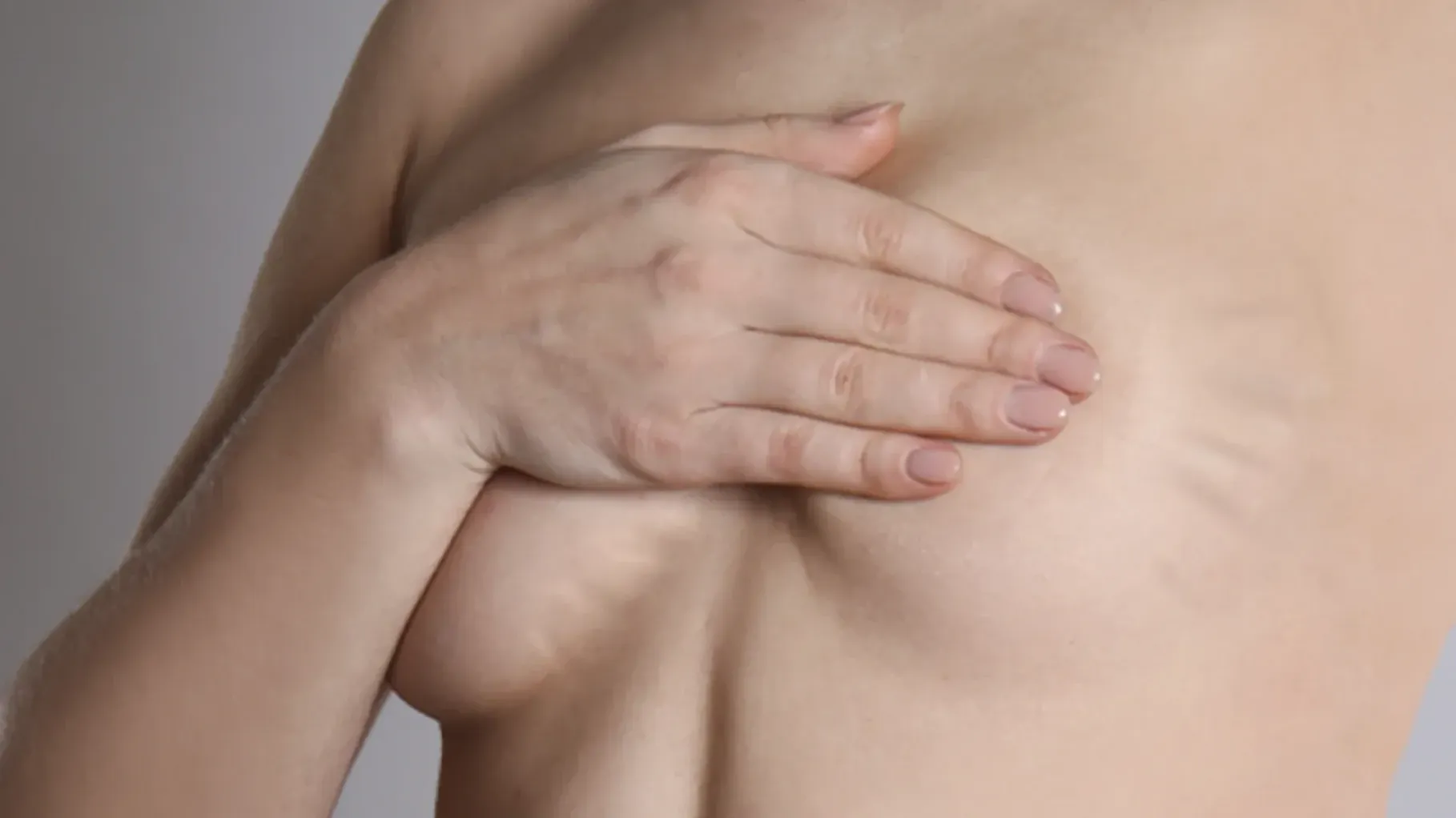
Rippling is visible or palpable wrinkling of the breast skin over an implant, caused by tissue coverage that is too thin. It shows mostly in the cleavage area and along the edges of the implant, and it is more common in very slim patients whose implant sits above the muscle. It is not a health risk. It is a cosmetic issue that can be prevented by choosing the right implant pocket and, once it appears, corrected by adding thickness to the coverage.
With Dr. Víctor Cabrera Mas, plastic surgeon on the breast surgery team.
Book your breast augmentation assessment

What exactly is rippling?
Rippling is a condition seen in cosmetic breast surgery where folds or waves become visible on the breast skin. What you actually see are the ripples of the implant itself, showing through because the layer of skin, fat and breast tissue on top of it is not thick enough to hide them.
Some patients only feel it, as an edge or a fold under the skin. Others can see it clearly, mostly in the upper part of the breast around the cleavage, although it can also appear on the side or the lower part of the breast.
Video in Spanish.
Why does rippling appear after breast augmentation?
It appears when implant coverage is too thin. In our practice we see it mostly when several of these factors come together:
- Little natural tissue. Very slim patients with little breast tissue and little fat have less to cover the implant.
- Implant placed above the muscle. In the subglandular position, meaning right under the breast tissue, only the skin and the breast cover the implant. If that tissue is thin, wrinkles show in the cleavage.
- An implant too large for the patient's tissue. The more volume we ask of thin coverage, the more it stretches and the more the edges show. That is why we measure before choosing a size (see how to choose breast implant size and is a 350cc implant too large?).
- Implant type. Saline implants and low cohesive silicone implants, meaning a more fluid gel, fold more easily.
It can also appear over time if a patient loses a lot of weight, and with it some of the fat in her breasts.
Is rippling dangerous?
No. Rippling is a cosmetic issue and does not pose a health risk. On its own it does not mean the implant has ruptured or that there is a complication.
That does not mean it doesn't matter. Some patients are very bothered by seeing it in their cleavage or feeling it under the skin, and in those cases it can be treated.

How do we prevent rippling in breast augmentation?
We prevent it by giving the implant enough coverage from the first surgery. Depending on each patient's tissue, we use one of these techniques:
- Dual plane. We place the implant under the pectoral muscle, so its upper part is covered by muscle as well as skin and breast tissue. This is the option that best protects the cleavage area.
- Subfascial plane. In some patients we place the implant under the fascia, the thin membrane covering the muscle. It adds a layer of coverage without going under the muscle.
- Fat transfer. We take fat from another area of the patient's body and graft it into the breast to thicken the tissue covering the implant.
All three aim for the same thing: thicker tissue that protects the implant and keeps wrinkles from showing. Pocket and size are chosen when planning the breast augmentation, after measuring each patient's tissue.
How is rippling fixed once it has appeared?
It is fixed by increasing implant coverage, which almost always requires another surgery. First we assess where it shows, how much tissue the patient has and where the implant sits.
- Changing the implant pocket. If the implant is above the muscle, we move it to a dual plane so the muscle covers the upper part. This is done as part of a breast implant replacement.
- Grafting fat to the area. Fat transfer thickens the tissue exactly where the ripples show. It can be done on its own or together with a pocket change.
- Changing the implant. If the implant is too large for the tissue or has a low cohesive gel, we consider a smaller or more cohesive one.
We often combine two of these options. If you are thinking about replacing your implants for another reason, it makes sense to plan both together; more in how often breast implants should be replaced.
Related reading: Breast augmentation before and after · Preservé technique
Rippling FAQ
Does rippling go away on its own?
When rippling is caused by thin coverage, it does not usually go away on its own, because the tissue does not thicken by itself. In the first weeks after surgery swelling changes how the breast looks, so we assess it once the result has settled.
Can rippling be corrected without surgery?
A lasting correction means increasing implant coverage, and that requires surgery: a pocket change, fat grafting or a new implant.
Does the implant brand affect rippling?
What matters is the implant type: the fill, how cohesive the gel is and whether the size suits the patient's tissue. Choosing these features and the pocket well matters more than the brand.
Who is most at risk of rippling?
Very slim patients with little breast tissue and fat, especially if the implant sits above the muscle or is large for their tissue. Also patients who lose a lot of weight after surgery, something we often see with empty breasts after weight loss.
Does rippling mean the implant has to be removed?
Not necessarily. Most cases are corrected by changing the pocket or adding fat. If a patient would rather not have implants, breast implant removal is also an option we discuss with her.